Shopping Isn’t Just a Website Anymore
For the last 20 years, e-commerce has had a pretty consistent “shape”: a shopper finds a product (search, social, marketplace), clicks through to a product page, adds to cart, then checks out inside a store’s site or app.
Agentic AI breaks that shape.
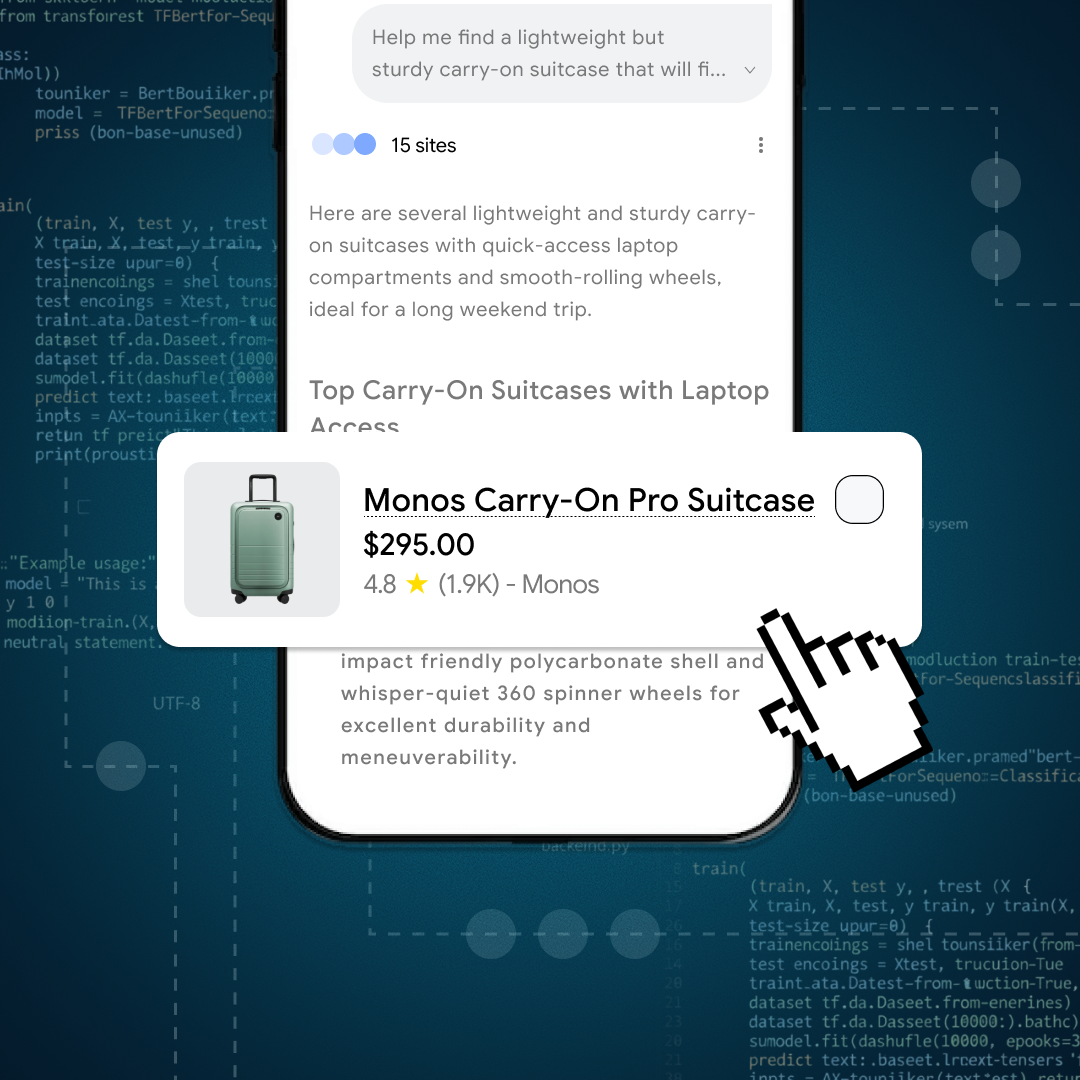
When shoppers ask Google’s AI Mode or Gemini something like “find the best lightweight suitcase under $200 that arrives by Friday,” they’re not just browsing. They’re delegating. And delegation only works if the AI can do more than recommend products. It needs a reliable way to discover inventory, confirm pricing, build a cart, authenticate a buyer, handle payment, and manage post-purchase tasks like shipping updates or returns.
That’s the problem Google’s Universal Commerce Protocol (UCP) is built to solve. UCP is a new open standard designed to let AI agents and commerce systems speak the same language across the entire shopping journey from discovery through checkout and beyond.
And the bigger story isn’t “Google added a buy button.” It’s what happens when commerce becomes something that can happen inside a conversation, anywhere.
What UCP is and what it actually does
At a high level, UCP is an open, shared protocol for “agentic commerce”: systems where AI can take actions on a shopper’s behalf, not just provide information. Google describes UCP as a standard that enables direct purchases across its AI surfaces (AI Mode in Search and the Gemini app), aiming to reduce checkout friction and cart abandonment.
Here’s the important part: UCP isn’t just a Google thing. It was co-developed with major commerce players, including Shopify, Etsy, Wayfair, Target, and Walmart, and Google says it’s endorsed by more than 20 additional companies across payments and retail.
So what does UCP do in practice?
1) Standardizes the “conversation-to-transaction” handoff.
UCP defines how an agent (like Gemini) can move from “here are options” to “here’s a confirmed order,” without custom one-off integrations for every retailer and every AI platform. Search Engine Land summarizes this as a shared language that removes the need for bespoke connections across agents or platforms.
2) Gives merchants structured control over what they support.
In Google’s implementation guidance, merchants publish a “business profile” at a well-known endpoint (/.well-known/ucp) that lists supported services, protocol version, and capabilities (checkout, fulfillment, discounts, etc.). That lets systems negotiate what’s possible before anything happens.
3) Enables a checkout flow that’s agent-friendly but buyer-safe.
For the “native checkout” path, Google’s guide outlines a REST API pattern for creating, updating, and completing checkout sessions. Crucially, the flow includes a deliberate handoff to a Google UI for sensitive steps like payment and fulfillment details so the agent isn’t improvising the most error-prone part of commerce.
4) Extends beyond purchase into lifecycle events.
UCP isn’t stopping at “buy.” Google’s documentation includes post-purchase order lifecycle updates via webhooks (order created, shipping updates, cancellations, etc.).
Google also positions UCP as compatible with other emerging standards like Agent2Agent (A2A), Agent Payments Protocol (AP2), and Model Context Protocol (MCP). That’s a signal they’re trying to build a connective layer, not a walled garden.
Why Google is pushing UCP now (and what it signals about the next era of e-commerce)
If UCP feels “sudden,” it’s because consumer behavior is moving faster than most commerce stacks.
Adobe reported that traffic to retail sites from generative AI tools during the 2025 holiday season increased by 693.4% year over year. Even if that’s from a modest base, the direction is loud: shoppers are already using AI as a discovery engine.
Google’s bet is straightforward: if product discovery increasingly happens inside AI surfaces, the platform that can also complete the purchase captures more value. Google’s own announcement says UCP will soon power checkout for eligible U.S. retailers directly in AI Mode and the Gemini app, using Google Pay with shipping and payment details stored in Google Wallet (with PayPal support also planned).
That has three major implications:
1) The point of conversion is migrating upstream.
Historically, the most valuable real estate in e-commerce was the product detail page and the checkout flow on the merchant’s site. With agentic shopping, conversion can happen at the moment of intent before a shopper ever “visits” a store.
2) “Interoperability” becomes a growth strategy.
UCP is designed to reduce fragmentation. Instead of every merchant building custom integrations for every AI agent, the protocol aims to create a repeatable pattern that works across surfaces and providers.
3) Trust becomes a technical requirement, not just a brand one.
Google’s UCP page emphasizes that merchants remain the Merchant of Record and retain customer relationships and data, while UCP establishes an accountability trail among merchants, credential providers, and payment services.
That language matters, because the biggest barrier to agentic commerce isn’t capability, it’s confidence.
What UCP means for the e-commerce ecosystem: Amazon, Shopify, and everyone in between
Let’s get practical. If UCP (or something like it) becomes the standard, it reshapes power dynamics across the e-commerce universe.
Amazon: less dominance at the top of the funnel, more pressure to play defense
Amazon’s core advantage has always been a brutally effective combo: selection, price competition, and fulfillment infrastructure. UCP doesn’t replace that.
But it does challenge something Amazon has benefited from for years: the assumption that shopping starts inside Amazon’s experience.
GeekWire captured this nuance well: UCP may not threaten Amazon’s logistics empire, but it could challenge the idea that shopping must begin inside Amazon’s app or website, turning AI platforms into additional discovery (and potentially conversion) channels.
If consumers increasingly delegate shopping research to agents, Amazon becomes “one option” among many, especially for commodity categories where brand loyalty is weak and speed/price rules. Amazon will likely respond in one (or more) familiar ways:
- Make its own agentic layer unavoidable (tighter AI shopping inside Amazon).
- Push its marketplace economics harder (Prime perks, ad products, seller tooling).
- Decide whether to support open standards or keep everything proprietary.
The strategic takeaway: Amazon stays powerful, but UCP creates credible alternatives for where shopping can start.
Shopify: a massive tailwind because Shopify wins when commerce is everywhere
Shopify didn’t just “support” UCP; it co-developed it with Google, and it’s positioning itself as the backbone for commerce across AI channels.
Shopify describes UCP as an open standard for integrating commerce with agents, featuring “universal primitives,” standardized operations (discovery, checkout, orders, post-purchase), and extensions for custom needs such as discounts and fulfillment rules.
More importantly, Shopify is packaging this into a go-to-market story: Shopify merchants will be able to sell directly in Google’s AI Mode and Gemini, and Shopify says these AI integrations can be managed centrally from Shopify Admin via “Agentic Storefronts.”
Translation: Shopify is racing to become the “commerce layer” that any agent can plug into. If the web shifts from “sites” to “conversations,” Shopify wants to be the infrastructure behind transactions, no matter where they occur.
Everyone else: the next competitive edge is “agent readiness”
For DTC brands, marketplaces, and retailers, UCP signals a new baseline expectation: your commerce system needs to be programmable for agents.
That doesn’t mean you need to rebuild everything tomorrow. But it does mean your next-era e-commerce checklist expands:
- Data quality moves from “SEO nice-to-have” to “transaction-critical.”
If an agent can buy, your product data, shipping rules, taxes, inventory, and policies can’t be fuzzy. - Checkout becomes a platform integration, not just a UX flow.
Google’s native checkout approach is literally API-driven session management.
Even if you’re not implementing Google’s flow directly, the industry direction is clear. - Post-purchase is part of discoverability.
UCP’s roadmap priorities explicitly point to deeper support for the full consumer journey, including cart building, loyalty/member benefits, and lifecycle management.
In the old world, you could treat “discovery” and “operations” as separate departments. In the agentic world, they’re fused. The agent can’t recommend what it can’t reliably purchase and support after the fact.
UCP is early, and standards always evolve. But the headline is already written: commerce is becoming an interoperable capability that can live inside any interface that captures intent.
If you sell online, the question isn’t whether Google’s UCP is the standard yet. The question is whether your business is ready for a world where the store is no longer the destination, it’s the endpoint your systems expose to whatever agent wins the customer’s attention.